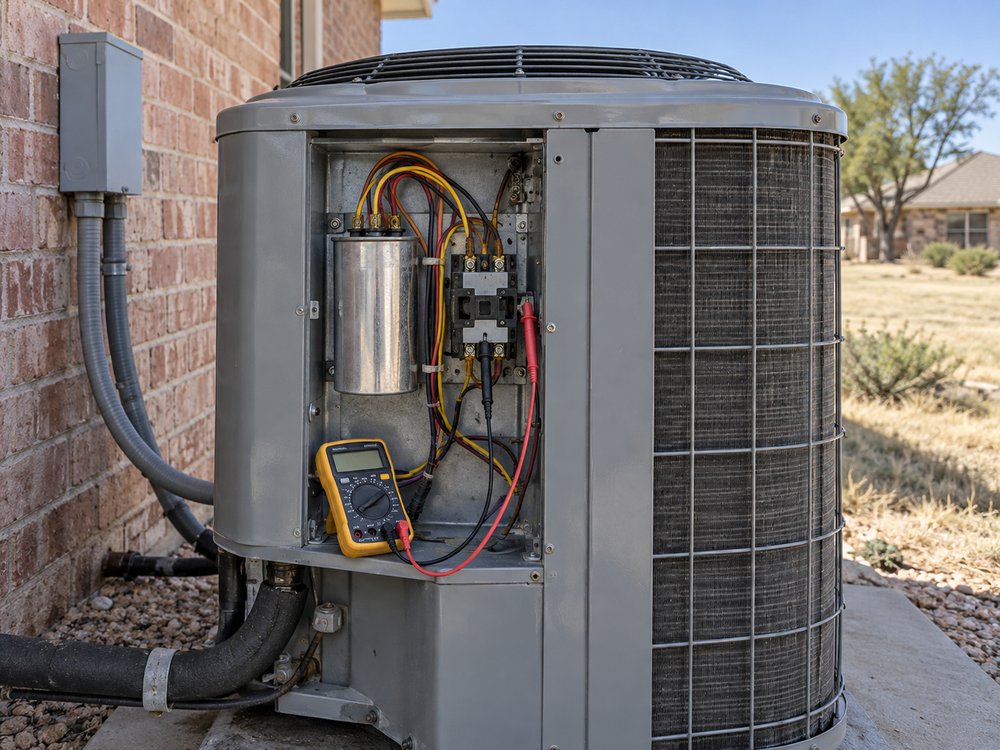
Repair first, because most calls are a repair. Then the two things that actually decide whether a house is comfortable: the ductwork, and whether the system was ever the right size for the building.
A no-cooling call in August is not the moment to be sold a system. The first things we check are the things that cost almost nothing to put right — a run capacitor, a contactor with burnt points, a float switch that has done its job because the drain is blocked, a filter nobody has changed, a thermostat that lost its programme, a breaker.
If the answer turns out to be the compressor, you will hear it with the reading that says so, not as an assertion. And you will get the choice between repairing it and replacing it laid out with real numbers on both sides, including the ones that make repair look better.
The two big ones
Ductwork, and size
01
The attic is usually where it went
In most Abilene houses the ductwork and often the air handler are in an attic that reaches well over 130°F on a July afternoon. Every leak on the return side is drawing that air straight into the system, and every leak on the supply side is air conditioning the roof space.
We measure it. Static pressure across the system, and a leakage test rather than a torch and an opinion. A house that has never cooled properly since it was built is very often a duct problem that has been diagnosed as a capacity problem for twenty years.
02
The size on the old plate is not evidence
The single commonest way a replacement system is specified is by reading the old one and matching it. That is not a calculation. It carries forward whatever mistake was made the first time, and it ignores everything that has happened to the house since — new windows, a re-roof, insulation, an addition, a converted garage.
We run a load calculation from the building and give you the sheet. There is a whole page about this and it will save you money even if you never ring us.
Usually an oversized system. Cooling and drying are two different jobs and the drying only happens while the machine is actually running. A system that satisfies the thermostat in eight minutes never runs long enough to take moisture out, so you get a cold clammy house and a compressor that is starting and stopping all day.
02
“The house is dusty”
Usually a filter path rather than a filter grade. If the cabinet does not seal around the filter, or the return is pulling from the attic through a gap at the plenum, a better filter changes very little because most of the air is going around it. Fixing the path costs less than the filters do.
03
“The back bedroom is always hot”
Sometimes a damper, sometimes a crushed flex duct behind an access hatch, sometimes a room that was added without anyone adding duct to it, and quite often a return path — air cannot leave the room, so it will not come in either. We measure before proposing anything.
Winter
Gas heat and heat pumps
01
Gas
Combustion tested and the figures recorded, heat exchanger inspected, flue and combustion air checked as installed rather than as drawn. If a CO alarm has ever sounded in the house we want to know before we start.
02
Heat pump
Defrost proved rather than assumed, and auxiliary heat checked for running when it should not be. On a heat pump the strip heater is the expensive part, and a thermostat set to recover quickly every morning will bring it on every mild day of the winter. That is a settings problem showing up as a bill.
Replacement
How we would rather do it
Look at the ductwork first. Calculate the load from the house. Put the sheet in your hand. Then talk about equipment, and only then about money. A correctly sized system installed on bad ductwork will disappoint you exactly as reliably as the old one did, and we would rather tell you that before you spend anything.